Pasqueflower (Anemone patens)
Buttercup Family (Ranunculaceae)
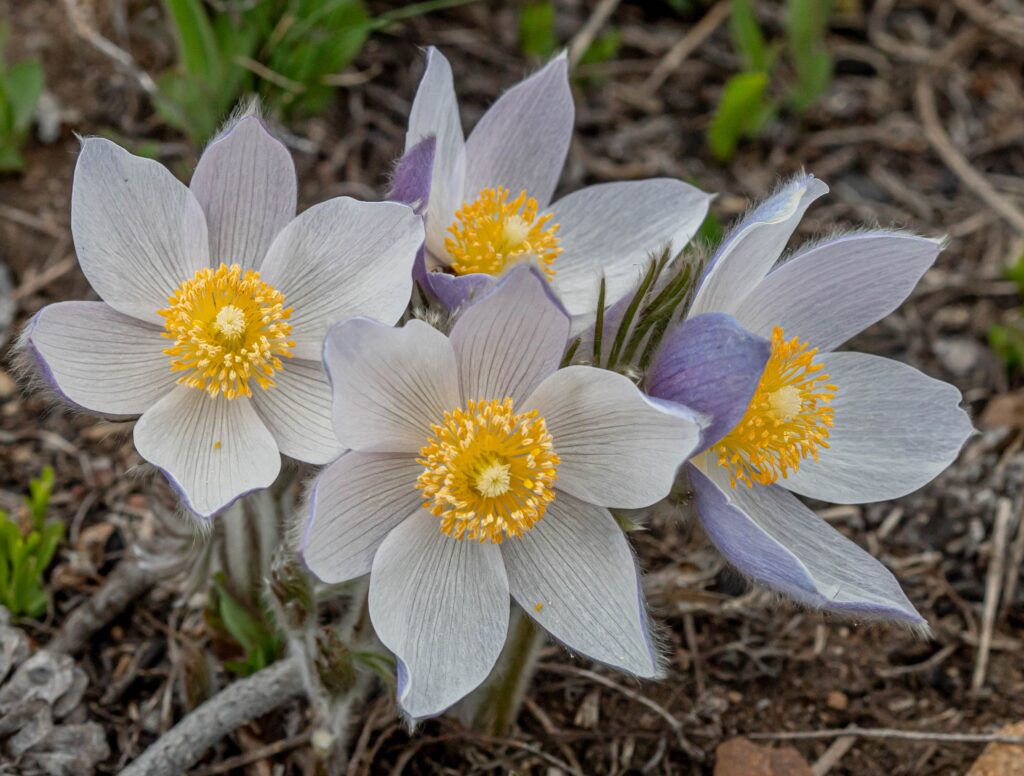
The fuzzy, purple flowers of pasqueflower are a familiar sight across much of Montana. It gets its name from the Old French word pasque, which means Easter, and the Hebrew word pasakh, which means Passover. This refers to its bloom time, often coinciding with the seasons in which those occur. The whole plant, even the underside of the petals, is densely-covered in these fine, soft hairs. They were created this way to help the plant survive the often cold, wind-swept habitats it often grows in. These places can be subject to snow and freezing cold during the duration of the plant’s growth cycle.
Pasqueflowers are perennial plants, coming up and blooming year after year. At flowering time, they are usually between four and six inches tall, give or take. However, as fruiting progresses, the plants can attain heights of up to a foot and a half. The leaves are mostly basal, with a leafy bract (leaf-like structure) partway up the stem. The leaves have three leaflets that are deeply divided all the way down to the point that they attach to the leaf stalk, creating a series of linear segments. They are often greatly reduced at flowering time, only expanding once flowering has finished and the plants have begun fruiting. There is only one flower per stalk, and it has no petals. Instead, the five to eight sepals (the part that normally protects the flower as it develops) take on the role of petals. They are anywhere from pale to deep purple, (occasionally, but very rarely, white). Numerous yellow stamens and purple-tipped stigmas adorn the center of the flower. These eventually give way to a globe-shaped arrangement of feathery stalks, each with a single seed attached to it.
This species grows in a number of different habitats across most all of Montana. Grasslands, steppe, and open forests, from the plains all the way to above the treeline. Pasqueflower begins flowering quite early, sometimes as early as March, and can continue all the way into June the higher up you go in elevation.
As usual, this plant is best left in the wild to do its thing and to be enjoyed by others. Please refrain from picking or digging it up, as it rarely survives, and robs the plant of its opportunity to reproduce and create more. If you are interested in growing this plant in your garden, seek out legitimate native plant nurseries.
By Buck Fitzhugh: April 4, 2026 – Great Falls, Mt

Author: Staff
Our Staff account is used to publish submitted content. If you have content that was published under this account, and wish to have your name as author, please contact us at (406) 952-3021