Steer’s Head (Dicentra uniflora)
Fumary Family (Fumariaceae)
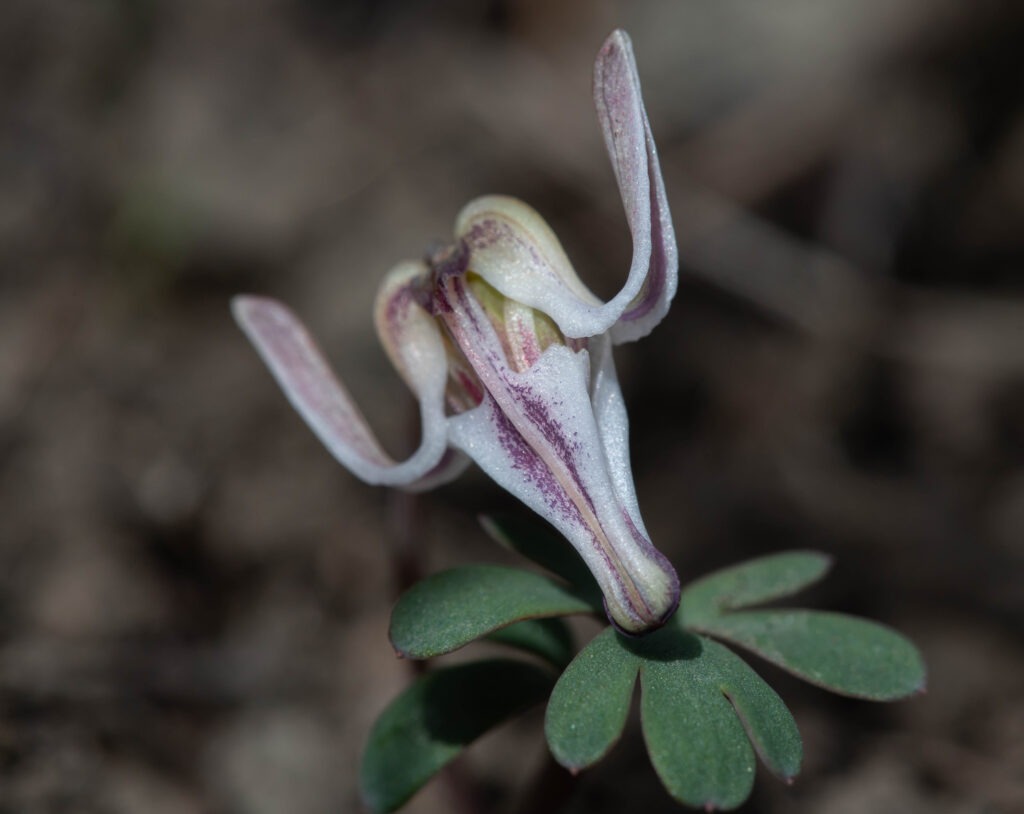
The flowers of steer’s head are very appropriately named. It evokes images of tiny little bovine heads lying on or near the ground. This is one of the most unique and easily identifiable native species, if you can find it. The genus name means “two-spurred,” referring to the spurs of the two outer petals. Uniflora refers to the fact that only one flower is on a stalk. This particular genus includes well-known plants such as the bleeding hearts, which are common in gardens. All but one species are native to the U.S., but this is the only member that is native to Montana.
Steer’s Head is a very small plant, no more than an inch or two tall at most. It is a perennial that grows from tuberous roots. The leaves are finely divided two or three times into narrowly oblong segments that are as long as the leaf stem itself. A single flower, less than an inch in size, terminates each stalk and is either white or pink. Each flower has four petals, two of which are horizontal to recurved, and spurred at the back. The other two are fused at the top to create the bulk of the “head” of the steer. The flowers are uniquely designed to be difficult to pollinate. Likewise, the bumblebees that are known to pollinate it are the only bees uniquely created to be able to force the petals back to get at the nectar, and thus get the pollen to transfer it to other flowers.
In Montana, steer’s head is only known from the western portion of the state, and is quite uncommon. At present, there are fewer than thirty known populations. These are very widely scattered across its range, too. It is possible, maybe even probable, that other populations exist. However, given its very small size and early bloom time, it is easily overlooked. It grows in areas with soil that is moist in the spring and often shallow in meadows, open forest, and rock outcrops. It can be found from the montane zone all the way to the subalpine.
Given this plant’s very uncommon nature, please refrain from picking or trying to transplant it. It would not take much to tip this plant into a decline.
By Buck Fitzhugh: April 24, 2026 – Great Falls, Mt

Author: Staff
Our Staff account is used to publish submitted content. If you have content that was published under this account, and wish to have your name as author, please contact us at (406) 952-3021