Rocky Mountain Maple (Acer glabrum)
Maple Family (Aceraceae)
Rocky Mountain Maple is one of only two maples native to Montana. It can be readily distinguished from the other because they occupy entirely different habitat types. The name Acer comes from the Latin for sharp, or pointed, referring to the iconic pointed leaves of most species. Glabrum comes from the Latin for smooth or hairless, referring to the leaves of this species being very smooth and without any hairs. Rocky Mountain Maple is an important forage species for animals such as deer and elk.
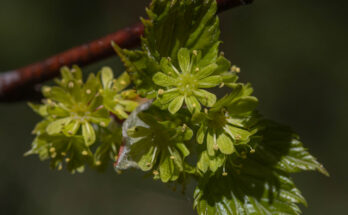
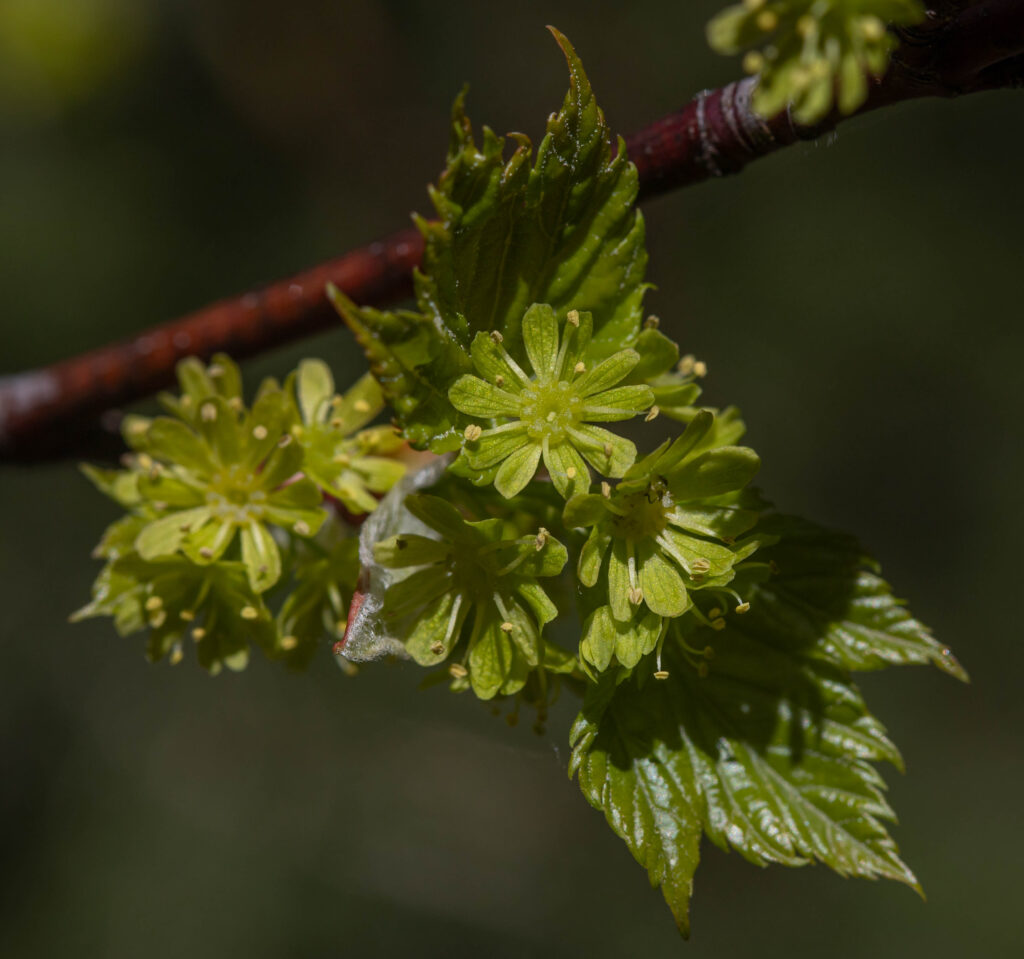
This is a large shrub or small tree, getting up to fifty feet tall. The twigs of Rocky Mountain Maple are red to purple. The leaves are broadly heart-shaped, with three to five pointed lobes. They are doubly serrate, meaning that the lobes have teeth that then have a toothed edge. The flowers are born in clusters arising from the twigs on leafy side shoots. The petals and sepals are both green and prominently veined. The flowers are functionally monoecious, meaning that there are separate male and female flowers on the same plant. The flowers are small, and often overlooked. They emerge at the same time that the new leaves do, and often bloom before the plant has fully leafed out. The fruit is your typical winged maple seed, known as a samara.
Rocky Mountain Maple has a very broad range in Montana, being found across much of the western, central, and southern portions of the state. As its name suggests, though, it is limited to the mountainous regions. It can be found in open coniferous forests that get a lot of moisture, and forests along streams/rivers. Elevation-wise, it grows from the valleys up to the subalpine zone. It can begin blooming as early as May, and go into June, depending on the elevation.
As this is a tree or large shrub, there is little risk of it being dug up from the wild, but as always, please refrain from trying to do so. It can be grown readily from seed sown directly after harvesting it. It is very cold-hardy, but does not tolerate hot, dry, windy sites well at all. It grows best in moist, well-drained rocky soils, with at least some shade during the day.
By Buck Fitzhugh: May 20, 2026 – Great Falls, Mt

Author: Staff
Our Staff account is used to publish submitted content. If you have content that was published under this account, and wish to have your name as author, please contact us at (406) 952-3021