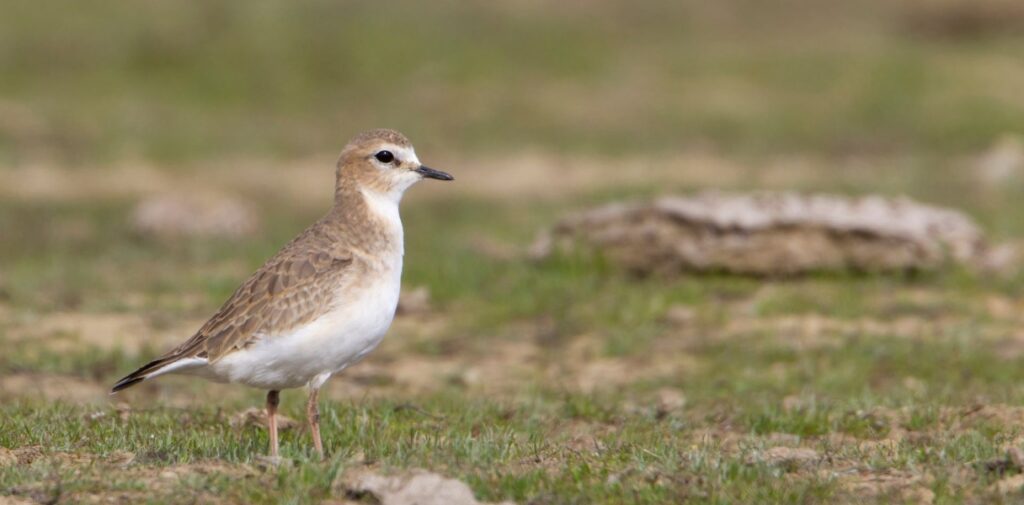
Mountain plovers, also known as “prairie ghosts,” exhibit a unique co-parenting strategy. These enigmatic birds inhabit shortgrass prairies and follow a two-nest rule: the female divides her clutch between two nests, with the male incubating one nest while the female incubates the other. They can lay between one and four eggs, with an average of three in each nest.
“The two-nest rule is thought to increase the likelihood that at least one brood survives by spreading the risk and not putting all their eggs in one basket, so to speak,” said Brandi Skone, Region 4 nongame wildlife biologist.
Despite their name, mountain plovers—classified as a Species of Greatest Conservation Need—do not actually inhabit mountainous regions. They were first observed in 1834 near the Rocky Mountains and were incorrectly thought to live in those areas; it turns out they are, in fact, prairie birds.
Their habitat spans from southern Canada to northern Mexico. Historically, mountain plovers were associated with lands grazed by bison. In more recent times, they have been linked to sheep-grazed lands and prairie dog towns, where the very short vegetation allows them to find their diet of insects, including grasshoppers.
“With sheep operations declining, an increase in introduced grasses, including crested wheatgrass and smooth brome, and a decline in prairie dogs from the onset of plague, we’ve seen a decline in suitable habitat along with declining bird numbers,” Skone said.
The global population of mountain plovers is estimated to be between 17,000 and 20,000. Data from the North American Breeding Bird Survey indicates that the species has declined by an average of 2.5 percent annually from 1966 to 2022, resulting in an estimated 75 percent population loss. In Montana, the species was considered extirpated in 2019 in parts of central and southwestern Montana, although populations in the northeastern part of the state have declined but are still considered stable.
FWP is actively involved in the International Mountain Plover Working Group, which was established in 2024. Through this involvement and collaboration with various partners, FWP is working to contribute to a range-wide assessment to update the population estimates.
If you see a mountain plover, please report it to FWP. Given the cryptic nature of these birds and the challenges associated with identification, FWP asks that you include a photograph with your observation.

Author: Karen Anderson
Karen is the Editor-in-Chief overseeing all news operations at Foxys Publishing Co. She also loves photography and spending time with her dogs.