Elk Sedge (Carex geyeri)
Sedge Family (Cyperaceae)
Elk Sedge is one of our first sedges to bloom in the spring. It is not anywhere near as showy as some of our other native species. At first glance, it could easily be mistaken for a grass. It is a graminoid, or grass-like plant. Sedges can be distinguished from grasses by their triangular stems. An easy way to remember is the following saying: Sedges have edges, rushes are round, and grasses have joints, referring to their jointed stems. Elk Sedge is sometimes known as Geyer’s Sedge, being named after Karl (Charles) Andreas Geyer. Geyer collected several thousand plant specimens in the early to mid-nineteenth century across parts of the upper Midwest and into the Pacific Northwest.
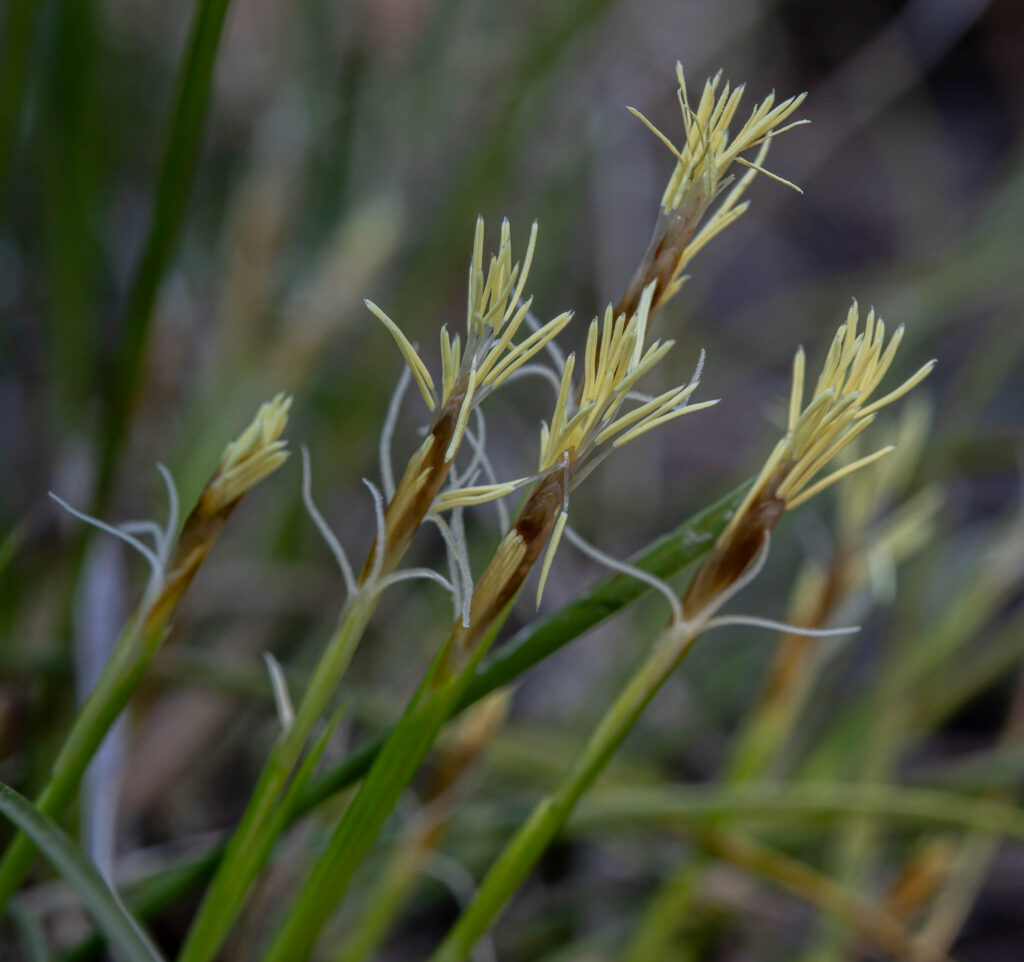
Elk sedge is fairly non-descript. It is only a few inches tall at flowering time. It grows from a very densely tufted (caespitose) cluster of leaves, all of which are stem leaves. The basal leaves lack blades entirely. As the plant matures, the leaves get longer, and the plant becomes fuller, showing the characteristic tufted growth form. The flowers are imperfect, meaning they are all male or all female. The male flowers are located near the top of the inflorescence (flower cluster), consisting only of stamens. The female flowers are at the bottom, consisting only of pistils. Between one and three fruits develop after pollination. The fruits of sedges are known as perigynia, and are key to making a positive identification. Elk sedge usually has between one and three perigynia, making it one of the easiest sedges to identify in Montana. This is helpful because there are over one hundred and twenty species of sedge native to Montana, making it the largest native genus in the state.
This species is fairly widespread in the state, being found in many of our western and central mountain ranges. It makes its home in many different habitats, from open forests to meadows and grasslands. It grows in valleys all the way up into the alpine zones. Elk sedge sometimes begins flowering as early as late April and lasts well into August at the higher elevations.
Even though this plant does not have brightly-colored flowers, it is still a delight to encounter. Not many people take the time to stop and admire a sedge. Given all of this, it is not likely to be dug up or picked, but as always, please just admire it, take a photo, and leave it be to do its thing.
By Buck Fitzhugh: May 2, 2026 – Great Falls, Mt

Author: Staff
Our Staff account is used to publish submitted content. If you have content that was published under this account, and wish to have your name as author, please contact us at (406) 952-3021