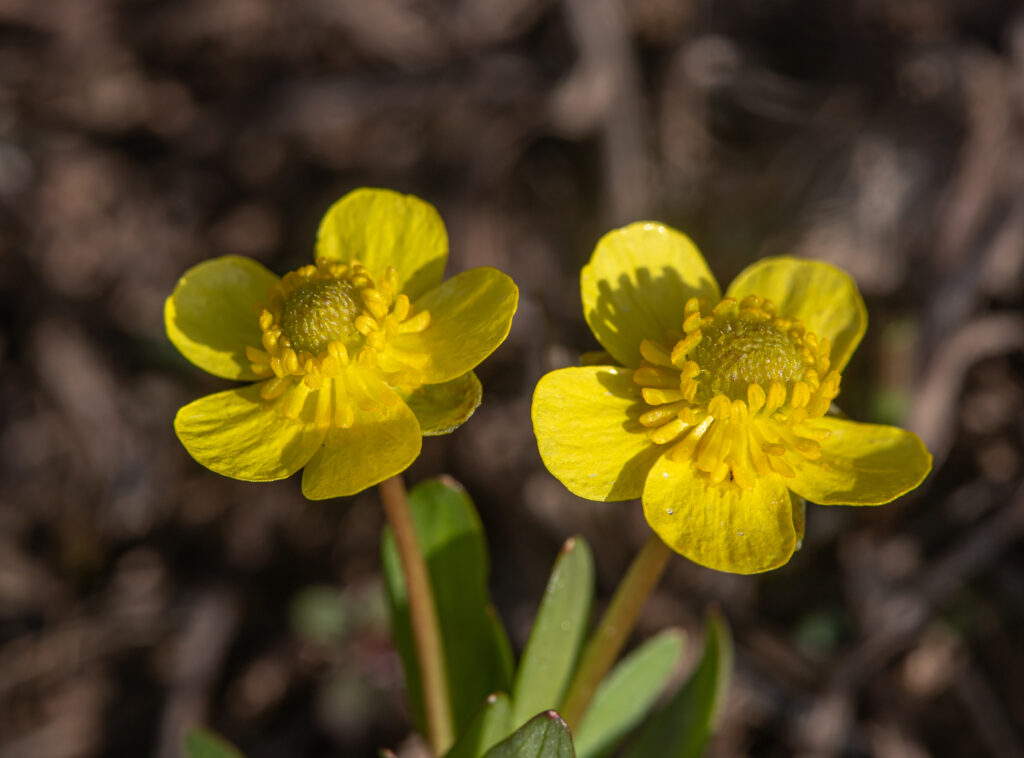
Sagebrush Buttercup (Ranunculus glaberrimus)
Buttercup Family (Ranunculaceae)
The bright, lemon-yellow flowers of the sagebrush buttercup are often one of the very first flowers to bloom in Montana. Their appearance announces that spring is not all that far off. If conditions are right, they can be seen as early as January or February. However, it typically begins blooming in March and April, lasting through about June at higher elevations.
Sagebrush buttercup is a short plant, no more than about half a foot tall. It has two sets of leaves, one that grows at the base and one that grows along the stem. The leaves at the base are elliptical to ovate (egg-shaped), and sometimes lobed along the edges. The stem leaves are deeply lobed. The flowers have five or more shiny, bright yellow petals that form a sort of bowl, or cup, likely giving rise to their common name. The genus name Ranunculus comes from the Latin for “little frog”, and is probably due to the fact that many species in the genus have a preference for damp habitats.
This species is very widespread in Montana, and can be found across most of the state, but is particularly abundant in the western half. It occupies a diverse range of habitats from grasslands, steppe, open forests, and rocky outcroppings. It is mostly a low-elevation species, typically inhabiting the plains to mid-level elevations. It can be seen growing above six thousand feet, but more often than not, you will find it down low. It is not uncommon for it to be found in great numbers when it is seen.
So, if you happen to be out hiking through the mountains or the plains between March and June, keep an eye out for this delightful little plant.

Author: Staff
Our Staff account is used to publish submitted content. If you have content that was published under this account, and wish to have your name as author, please contact us at (406) 952-3021