Fairy Slipper (Calypso bulbosa)
Orchid Family (Orchidaceae)
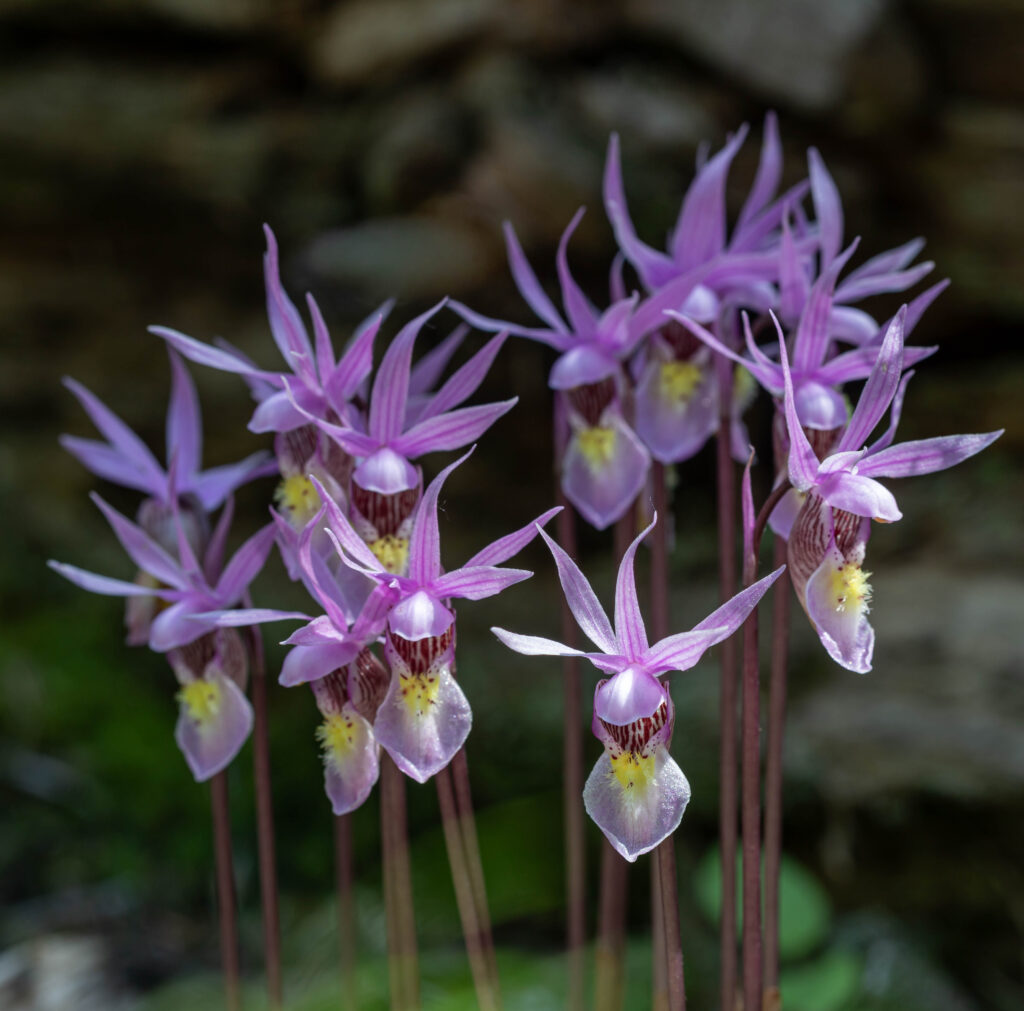
The fairy slipper is one of our more widespread orchids. Like tiny little pink slippers adorned with ribbons, they begin popping up in mid-spring in our coniferous forests. The genus Calypso has ties to ancient Greek mythology. It means “she who conceals”. In Greek mythology, Calypso was a sea nymph who hid Odysseus on her island. For the plant, it alludes to this plant’s elusive nature, hiding amongst the deep shade of our undisturbed forests. Bulbosa refers to the plant’s bulbous root.
Fairy slipper is not a tall plant, at most getting just shy of a foot tall at full maturity. Each plant grows from a swollen, bulb-like root and produces a single leaf. The leaf is ovate (egg-shaped), at the base of the plant, and noticeably pleated. A single flower terminates each stalk. The flowers have three pink, petal-like sepals that are largely indistinguishable from the two upper petals. The lower petal, known as the lip petal, can be quite variable. It is inflated and always striped on the backside, but the upper surface can have zero to many spots, and has a tuft of white and yellow hairs near the opening. The fruit is a many-seeded capsule.

This orchid is found in many of Montana’s mountain ranges from the western half to the central third of the state. It only grows in coniferous forests, and they can be either dry or moist. It grows from the valleys up to the montane zone. Depending on the part of the state it is growing in, it can start blooming as early as mid-May. This makes it one of our earliest blooming orchids.
All orchids were created to have a relationship with fungi in the soil. In order to germinate, the seeds must be parasitized by fungi. The fungi provide vital nutrients that the orchids otherwise would not be able to obtain. It is for this reason, even though this is one of our more common orchids, that this (and all orchids) should never be dug up from the wild. This species is quite sensitive, in that even disturbing the root is enough to kill the plant. If you see it in the wild, please just admire it, snap some photos, maybe get down to its level to truly appreciate the beauty of this tiny gem, but do not try to transplant it.
By Buck Fitzhugh: June 4, 2026 – Great Falls, Mt